BUYING EQUITY: The “Execution Gap”
Why Stabilization Doesn’t Mean Easy Money in Philly’s Distressed Market

Weekly Distressed Market Report | Week Ending February 8, 2026
By Ronald Williams | Fathom Realty
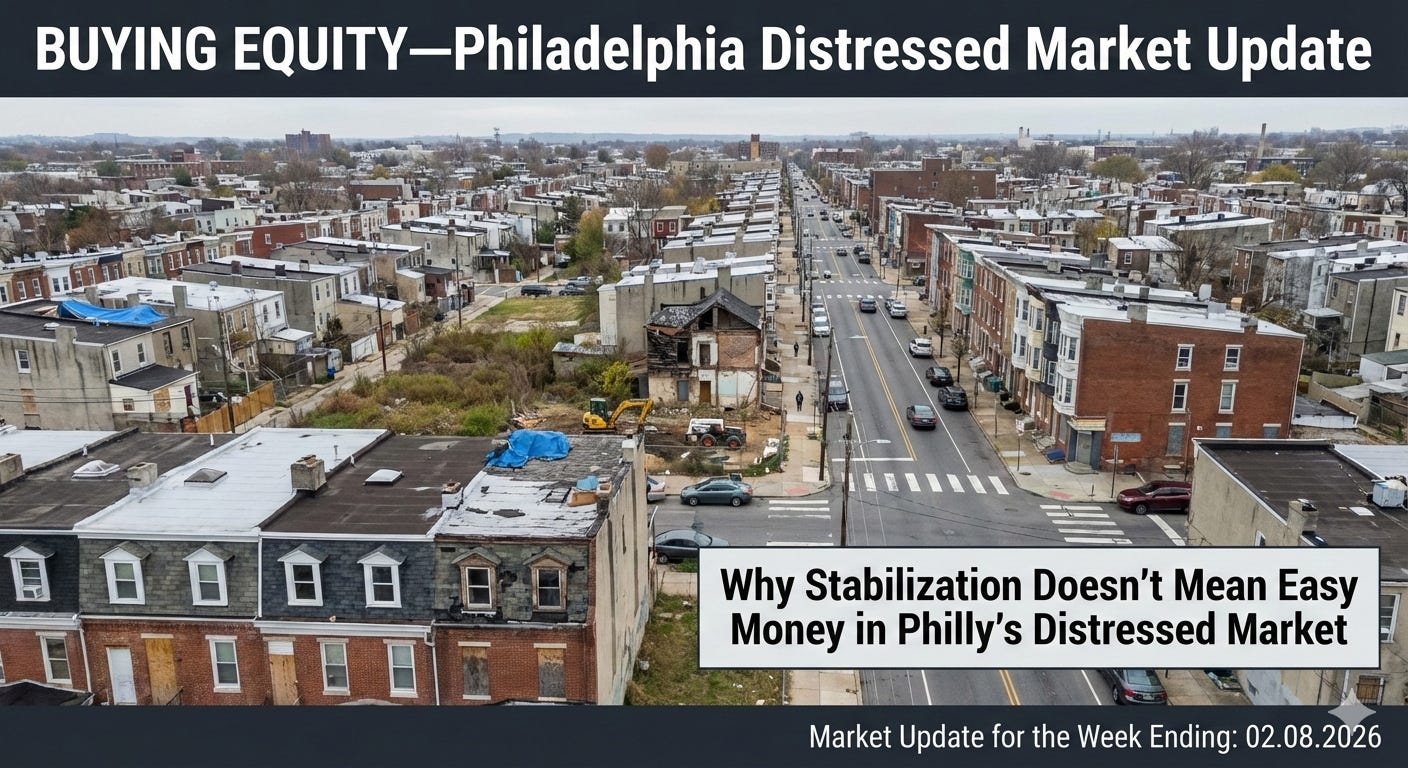
If January was the month of the inventory spike, early February is the month of the “reality check.”
For the week ending February 8, 2026, the distressed property market across the five-county Philadelphia area (Philadelphia, Delaware, Montgomery, Bucks, and Chester Counties) took a breath. After a surge of activity to start the year, we are seeing a distinct trend of stabilization rather than acceleration.
Total distressed listings dropped to 733, an 11% decline from January’s high of 825. On the surface, this looks like the market is drying up. But when you peel back the layers of the data, a more complex story emerges—one of high institutional control, geographic concentration, and a massive gap between getting a home under contract and actually closing the deal.
Here is your deep dive into the risks and opportunities in this week’s distressed housing market.
The Big Picture: Stabilization, Not Resolution
The narrative for this week is normalization. The 11% month-over-month drop in inventory suggests that the January surge was likely a seasonal backlog clearing out, rather than the start of a runaway foreclosure crisis. We are seeing the market digest that influx rather than choke on it.
However, the broader Philadelphia market remains cautious. While buyer engagement has rebounded following recent winter storms, sellers are still holding back new inventory. This has created a narrow but meaningful window of opportunity for distressed assets—but only if they are priced correctly.
The market is aggressively punishing “aspirational” pricing. We saw 32 listings temporarily withdrawn and 22 expire this week alone. This tells us that even in a low-inventory environment, buyers (and their lenders) are refusing to overpay for high-risk properties with unresolved condition issues. Sellers who test the market with unrealistic numbers are finding themselves stuck, forced to withdraw and reset rather than close.
Go Deeper: Access the Full Distressed Property Assessment
This article highlights only a portion of what’s happening beneath the surface of today’s distressed housing market. The full report this analysis is drawn from expands the data, context, and property-level insight needed to evaluate opportunity before making critical decisions.
Inside the full report, you’ll find:
A comprehensive, region-wide distressed market analysis
Condition- and pricing-based segmentation to identify where opportunity is forming
Clear explanations of how to interpret market friction and buyer leverage
If you value deeper insight into the distressed market—and want to learn how to analyze it with clarity and structure—your support helps make these reports possible.
Bonus: A full list of active distressed listings that have entered key marketing stages:
New Listings (0-10 DOM): 34 Listings (Price Range: $42K - $3M)
Target Listings (30-40 DOM): 26 Listings (Price Range: $30K - $899K)
Stalled Listings (90-100 DOM): 13 Listings (Price Range: $85K - $612K)
Organized to support disciplined opportunity screening
The “Execution Gap”: Why Deals Aren’t Closing
The most startling statistic from this week’s data isn’t the number of listings—it’s the conversion rate. The pipeline is full, but the output is a trickle.
Active Listings: 320
Pending/Contingent: 343
Closed Sales: 13
Only 13 distressed properties closed this week. That represents less than 2% of the total distressed inventory.
This highlights a massive “Execution Gap.” Getting a distressed property under contract is relatively easy right now; getting it to the settlement table is incredibly hard. The disparity between the 343 properties under contract and the 13 that actually closed signals significant friction in the transaction process.
Why is this happening? Distressed transactions are inherently “sticky.” Financing limitations for properties in poor condition, complex title issues that surface late in the game, and the sluggish bureaucracy of lender-approval processes are gumming up the pipeline.
The takeaway: If you are a buyer, patience is your currency. Expect extended timelines and be prepared for false starts. If you are a seller, you must resolve condition and title issues before listing if you want to be part of the 2% that actually closes, rather than the vast majority stuck in limbo.
Who Owns the Market? (Spoiler: It’s the Banks)
We are currently in a market dominated by institutions, not homeowners. This distinction is critical for understanding negotiation dynamics.
Bank-Owned (REO): 414 listings (The majority)
Short Sales: 121 listings
Probate/Estate: 88 listings
With 414 REO properties on the market, the banks are effectively calling the shots. Institutional sellers prioritize process and policy compliance over speed. Unlike an individual motivated seller who might drop the price to move on with their life, a bank works off a balance sheet and a rigid approval matrix. They are less emotional than individual homeowners but also significantly less flexible.
Interestingly, we are seeing very few “early-stage” distress signals. There are only 21 properties listed as “In Foreclosure” and 6 in “Bankruptcy.” This suggests that the current inventory is largely “legacy” distress—homes that have already moved through the lengthy court system—rather than a fresh wave of new homeowner defaults.
Geographic Deep Dive: The Tale of Two Markets
Distress in our region is not evenly spread; it is hyper-localized. This creates two completely different investment environments depending on where you look.
The Hot Zones (Philadelphia): Distressed inventory is heavily concentrated in specific Philadelphia corridors. If you are a value buyer, this is where the volume is:
19143 (Southwest Philly): 46 listings
19132 (West Philly): 43 listings
19121 (North Philly): 36 listings
In these zip codes, distressed properties are competing against each other. A block might have two or three REOs available simultaneously. This saturation gives buyers leverage to demand better pricing or condition concessions because they have alternatives.
The Suburbs: In contrast, distress in Bucks, Chester, Delaware, and Montgomery counties is appearing as isolated, one-off events. There are no “clusters” of distress in the suburbs. If you find a distressed deal in a desirable suburban school district, you are likely the only distressed option in the neighborhood. Consequently, competition for these “needles in the haystack” will be fierce, and prices will remain sticky.
The Pricing Reality
Average Closed Price: $237,250
Average Active List Price: $269,188
Average Days on Market (Active): 85 days
There is currently a roughly $32,000 gap between what sellers want and what properties are actually selling for. Furthermore, active listings are sitting for nearly three months on average. In a fast-moving market, 85 days is an eternity, and it usually signals that the price does not align with the property’s condition.
We are seeing two distinct “Opportunity Bands”:
Below $100k (48 listings): This is the cash-buyer/investor sandbox. These properties typically require major rehabilitation and are unfinanceable for traditional buyers. High condition risk, but high potential yield for those with construction crews on speed dial.
Above $500k (31 listings): This is the danger zone. High-end distressed homes are seeing extended market times, likely due to overpricing relative to the repairs needed. Buyers at this price point expect a certain level of finish, and the cost to bring a distressed luxury home up to par often exceeds the discount being offered.
Strategic Takeaways
For Investors (Fix & Flip): Margins are compressing. With average hold times extending and financing costs remaining real, you cannot afford to overpay on the front end. Focus on the REO segment where title issues are usually clearer, but budget for a longer closing timeline. Your underwriting must account for the “time cost” of money—if a project takes 4 months longer to close and sell, does the profit still exist?
For Landlords (Buy & Hold): While large multifamily deals are non-existent (only 3 buildings with 5+ units are listed), there are 22 small multifamily properties (1-4 units) available. In the targeted zip codes mentioned above (19143, 19132), these offer a path to value through renovation and rent stabilization. These assets allow for phased improvements—rehabbing one unit while the others generate cash flow.
For Distressed Homeowners: Time is not on your side. With the market dominated by REOs, you are competing against banks that can afford to wait. If you are facing foreclosure, waiting for the bank to take the property usually results in a total loss of equity. Engaging early—before it becomes an REO—is your only real leverage to control the exit terms and potentially salvage some value.
This report provides a snapshot of the distressed market for the week ending February 8, 2026. Real estate is local; always consult with a professional before making investment decisions.
Ronald Williams | Fathom Realty Phone: (215) 469-1382 Email: ronwilliams@fathomrealty.com Website: www.RWilliamsPropertyAdvisor.com